Monday, May 8, 2006

Meet Dana Rutledge


Our world-renown (and very modest) Dana Rutledge RN, PhD, is our Nursing Research Facilitator at St. Joseph Hospital in Orange, California. She is with us one day a week and leads our Nursing Research Council, along with Beth Winokur. How she manages to publish and research as much as she does, while at the same time remaining so friendly and approachable is a mystery to me. She very kindly provided me with a copy of her CV. It is so impressive that I hope it doesn't cause the blogosphere to crash!!

St. Joseph Hospital Evidence Based Nursing Practice (cont'd)

Sedation Management and weaning to facilitate extubation in the ICU

Investigator: Victoria Randazzo, RN, BSN, CCRN

Purpose: This multidisiplinary team is looking at the comprehensive way in which sedation (Benzodiazepines, Propofol) is managed in the intubated ICU patient. The intent is to promote a recognition of the ability to wean by using a daily "sedation vacation". The process utilizes a team approach between the staff nurse, the respiratory therapist and the Intensivist. This evidence based practice focuses on reducing ventilator associated pneumonia, shorter patient stays, reduced costs and better patient outcomes.
In addition to tracking patient outcomes, the process involves staff education which is facilitated by the team's ten member nursing staff and the clinical educator. Dr. Duke, one of the physician Intensivists, is offering the ICU staff a class titled "Sedation/Agitation in the Mechanically Ventilated Patient".


Friday, May 5, 2006

The Thrill of the Hunt

Be sure to check out the article in the latest issue of Advance for Nurses that spotlights Dana Rutledge, our own nurse researcher at St. Joseph Hospital. It can also be accessed online Enter "Dana Rutledge" in the search box.

Thursday, May 4, 2006

Meet the blog team


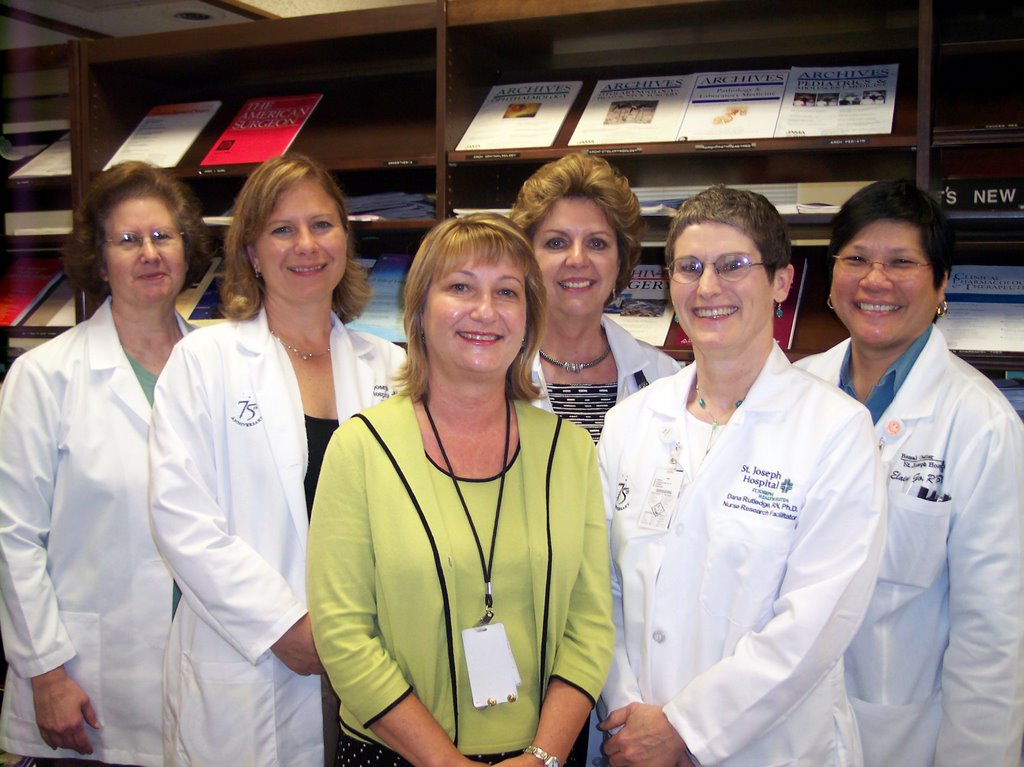
The blog team, from left to right are: Judy Rousch, Theresa Ullrich, Julie Smith, Ann Marie Keefer-Lynch, Dana Rutledge and Elaine Go. Not pictured is Linda Privette.

Please submit ideas for posting relating to nursing research/evidence based nursing to Julie at jsmith@sjo.stjoe.org

Wednesday, May 3, 2006

CDC issues guideline on "pre-conception care"

As part of an effort to reduce infant mortality and improve the health of newborns, the CDC’s National Center on Birth Defects and Developmental Disabilities yesterday issued new “pre-conception care” guidelines that encourage women to “take stock of their health” before attempting to become pregnant, HealthDay reports. The guidelines, which were published this month in the Morbidity and Mortality Weekly Report, were developed based on the results of a two-year “exhaustive data review” by the CDC and more than 35 government, public, and private groups. The guidelines recommend that women contemplating pregnancy schedule a pre-conception physician visit—an appointment that the CDC is urging health insurers to offer coverage for. In addition, the recommendations advise women to control chronic conditions such as high blood pressure, reach or maintain a healthy weight, avoid alcohol, quit smoking, and create “reproductive life plan[s]” with their partners that outline when and how many children couples wish to have. The associate director for program development says although steps to ensure pre-conception health have been recognized as important “for many years, they have really not been a part of the health care system.” Physicians already have embraced the new guidelines, which they say create an “organized approach for [physicians] giving advice to women.” HealthDay notes that the new recommendations will be widely distributed, with many of the sponsoring groups providing links to the recommendations on their official websites

Tuesday, May 2, 2006

Tips for Nursing School

A lot of people have posted comments or emailed me about their studies.

You guys ask "I am applying to clinicals next semester, what should I do?"
or "I'm about to take class X, is it hard?"
or "How did you know this was what you wanted to do?"
etc...

Well, I've been thinking about what I've learned over the last year and I think it's time I gave you some insider information. Here's a few things I've learned that may or may not help you out in school.

1) If you are thinking about going to nursing school but aren't there yet, volunteer at the hospital. I'm serious, it's not just for old ladies and community organizations. I was privileged enough to volunteer for a couple semesters at Hermann Memorial Hospital in downtown Houston. The place was massive and they had everything imaginable over ten floors in several buildings. I got to wander around all over the place and meet doctors and nurses and therapists of every kind. I got to see what the job was really like. It focused my goals.

Another solution would be to get a part time or summer job working in a hospital, though these are sometimes harder to come by. I have several friends who work as unit clerks or pharmacy techs... good jobs but not nursing jobs. I'm applying for a student nurse tech position for the summer... but I wasn't even eligible for it until I completed 2 semesters of clinicals. For students, hospital jobs can serve to ease your transition into the working world (if you can handle the extra stress). But they might not be the best way to feel out nursing as a potential major.

In any case, you can't really know if you want to do it without spending time in the hospital.

2) Go ahead and buy an NCLEX review book at the beginning of clinicals. Look on Amazon and try to find the one with the highest rating, especially one that has questions sorted out by topic with rationales for the answers. (Also, some instructors pull questions from review books... but that's not why I'm mentioning it.)

The thing about the NCLEX is that it asks you questions based on your ability and adapts to your level. The passing questions are based on synthesis and critical thinking, not recognition and recall. Sure, if you keep answering questions incorrectly the computer will eventually start asking you where the liver is. But you have to answer a minimum number of difficult questions to pass. You can answer every single anatomy question correctly from here to infinity and never meet the minimum requirements.

If you are attending a good nursing school, your instructors will try to format their test questions similarly to the passing NCLEX questions. They won't ask "What is this disease" as much as they will ask "What is the priority thing you need to watch when a person has this disease?" They won't ask "What does this medicine treat?" so much as they will ask "What lab value do you need to monitor when these two medicines are combined?" This principle should hold true for any course, so when you study you should try to think on a higher level than simple fact regurgitation. A review book might help you anticipate the kinds of questions your teacher will ask. Even if you never see the exact questions on your tests... you'll be more prepared for boards upon graduation.

3) Don't study for the grades. I know it sounds ridiculous, but your goal in studying shouldn't be to make A's. Studying isn't a product-oriented activity. It is process-oriented.

What good is school if you only cram enough facts in your head to pass a test? What good is your education if you stay up all night before each exam trying to store just enough info in short term memory to bump your grade up a letter? That kind of behavior was okay for English and Psychology... those things aren't your major. But nursing is something you'll have to do every day for work, and your mistakes won't take the form of typos. They'll take the form of injuries and deaths.

I know it isn't easy to do; we're all busy people. But if you make it your habit to reread the week's notes every day... if you make it your habit to learn and retain a little information each time... you'll gain more than class credit. You'll gain competency. Powerpoint is destroying our ability to take notes and listen actively. Printing out the slide handouts isn't enough.

Okay, so some of school is silly and useless. Something you have to get through before you go out into the real world and learn how things are done. Still, constant efforts really will carry you farther in life than intelligence alone. It becomes a matter of discipline and will.

4) Take time to play. But don't do it all the time. Some days you're just going to have to work hard from sun up to sundown. Just remember to relax on weekends. Take time to exercise. That freshman fifteen wasn't your birth control. It was your metabolism slowing down. Even if you only go for a walk on the weekend, it's better than nothing. Don't drink too much. Try to get off the caffeine and cigarettes. You're going to be a nurse; set a good example. The immediate gratification will cost more in the long run.

~~~
That's enough for now. More tips as I learn them.

One more thing: do you have a nursing/health blog or website? I know a lot of you read me but I haven't gotten around to reading linking you. Just post a comment with your URL, I'll check out your site and add you if I like what you have to say.

Monday, May 1, 2006

Julie's picks -- current nursing research articles April 2006

Rolfe G. Validity, trustworthiness and rigour: quality and the idea of qualitative research. Journal of Advanced Nursing. 2006 Feb; 53(3): 304-10.

Keeney S. Hasson F. McKenna H. Consulting the oracle: ten lessons from using the Delphi technique in nursing research. Journal of Advanced Nursing. 2006 Jan; 53(2): 205-12

Weaver K. Olson JK. Understanding paradigms used for nursing research. Journal of Advanced Nursing. 2006 Feb; 53(4): 459-69.

Upton D. Upton P. Development of an evidence-based practice questionnaire for nurses. Journal of Advanced Nursing. 2006 Feb; 53(4): 454-8

Marklew A. Body positioning and its effect on oxygenation -- a literature review. Nursing in Critical Care. 2006 Jan-Feb; 11(1): 16-22

Lindberg DA. Integrative review of research related to meditation, spirituality, and the elderly. Geriatric Nursing. 2005 Nov-Dec; 26(6): 372-7

Pearson A. 30th Anniversary commentary on MacGuire J.M. (1990) Putting nursing research findings into practice: research utilization as an aspect of the management of a change. Journal of Advanced Nursing 15, 614-620. Journal of Advanced Nursing. 2006 Jan; 53(1): 73-4. (6 ref)

Houldin A. Curtiss CP. Haylock PJ. Executive summary: the state of the science on nursing approaches to managing late and long-term sequelae of cancer and cancer treatment. American Journal of Nursing. 2006 Mar; 106(3): 54-9.

Marchiondo K. Teaching tools. Planning and implementing an evidence-based project. Nurse Educator. 2006 Jan-Feb; 31(1): 4-6

Pepler CJ. Edgar L. Frisch S. Rennick J. Swidzinski M. White C. Brown T. Gross J. Strategies to increase research-based practice: interplay with unit culture. Clinical Nurse Specialist. 2006 Jan-Feb; 20(1): 23-33.

Duffy ME. Using research to advance nursing practice. Resources for determining or evaluating sample size in quantitative research reports. Clinical Nurse Specialist. 2006 Jan-Feb; 20(1): 9-12.

Craig SE. Does nurse-led pre-operative assessment reduce the cancellation rate of elective surgical in-patient procedures?: a systematic review of the research literature. British Journal of Anaesthetic & Recovery Nursing. 2005; 6(3): 41-7