Showing posts with label Vital Signs. Show all posts

Wednesday, October 27, 2010

Vital Signs - Blood Pressure

Blood Pressure

Vital Signs - Blood Pressure


Blood Pressure : Pressure of blood against the walls of the arteries

Systolic : Number that is on the top, and when heart is contracting

Diastolic : Number that is on the bottom, and when heart is at rest

Systolic range : 90 - 140

Diastolic range : 60 - 90

Hypertension : High blood pressure, above 140 systolic or over 90 diastolic

Hypotension : Low blood pressure, under 90 over 60

To measure systolic : Sound of first beat

To measure diastolic : No beat is heard

Hypertension thickens heart muscle (hypertrophy) and reduces chamber in size

Thigh cuff for large arms, Small cuff pediatrics

Sphygmomanometer is instrument use to take blood pressure

Pulse pressure: Difference between systolic and diastolic

Vital Signs - Pulse

Pulse

Vital Signs - Pulse


Rate is : Number of beats per minute

Rhythm is : Regularity of beats

Normal range of adults : 60 - 100 per minute

Pulse : Can be weak, bounding or absent for short period of time

Rhythm : Can be regular or irregular

Palpate for : Rhythm, rate, and strength

Optimal finding : 80 per min. strong, and reg.

Tachycardia : Over 100 beats per minute

Bradycardia : Under 60 beats per minute

To measure pulse : count 30 sec.X 2

For irregular pulse : count the full 60seconds

Auscultate : Use stethoscope

Pulse deficit : Difference of apical and radial.

Vital Signs Respirations

Respirations


Vital Signs Respirations


Respirations : How many breaths per minute

Adults: 12 - 20 / Infant slightly higher 20 - 40

Inhalation and Exhalation equals: 1 breath

To count breaths: Count 30 seconds by 2

Look for : Rhythm, rate, depth, and quality

Bradypnea: Under 12 breaths

Tachypnea: Over 20 breaths

Eupnea: Normal rate and depth

Apnea: Not breathing maybe 30 seconds or at all

Dyspnea: Difficulty in breathing

Orthopnea: Over bedside 90o postural position

Hyperpnea: Fast respirations

Cheyne Stokes: Increasing in rate and depth then periods of apnea - cyclic.

Kussmaul: Metabolic acidosis,usually the Diabetic. Rapid, very deep respirations intended to blow off carbondioxide.

Vital Signs - Temperature

Temperature


Vital Signs - Temperature


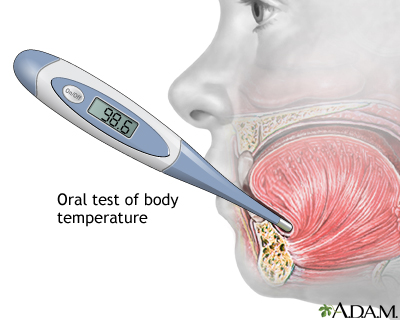
Oral - mouth

Time period 3 minutes
Normal range: 97.6 - 99.6 degrees
Absolute: 98.6 degrees

Rectal - Anus
Time period 3 minutes
Position -Lateral Sims
Normal range: 98.6 - 100.6 degrees
Absolute: 99.6 degrees

Axillary - Armpit
Time period 10 minutes
Normal range: 96.6 - 98.6
Absolute: 97.6 degrees
Otic or Tympanic Time period 10 sec. or less

Degree range is calibrated to rectal or oral
Hypothermia - Low body temperature
Hyperthermia - High body temperature
Pyrexia - High fever
Febrile - High fever
Afebrile - No fever

Things that can effect temperature: smoking, fluids, oxygen use, food, colds, or flu.(www.accessce.com)